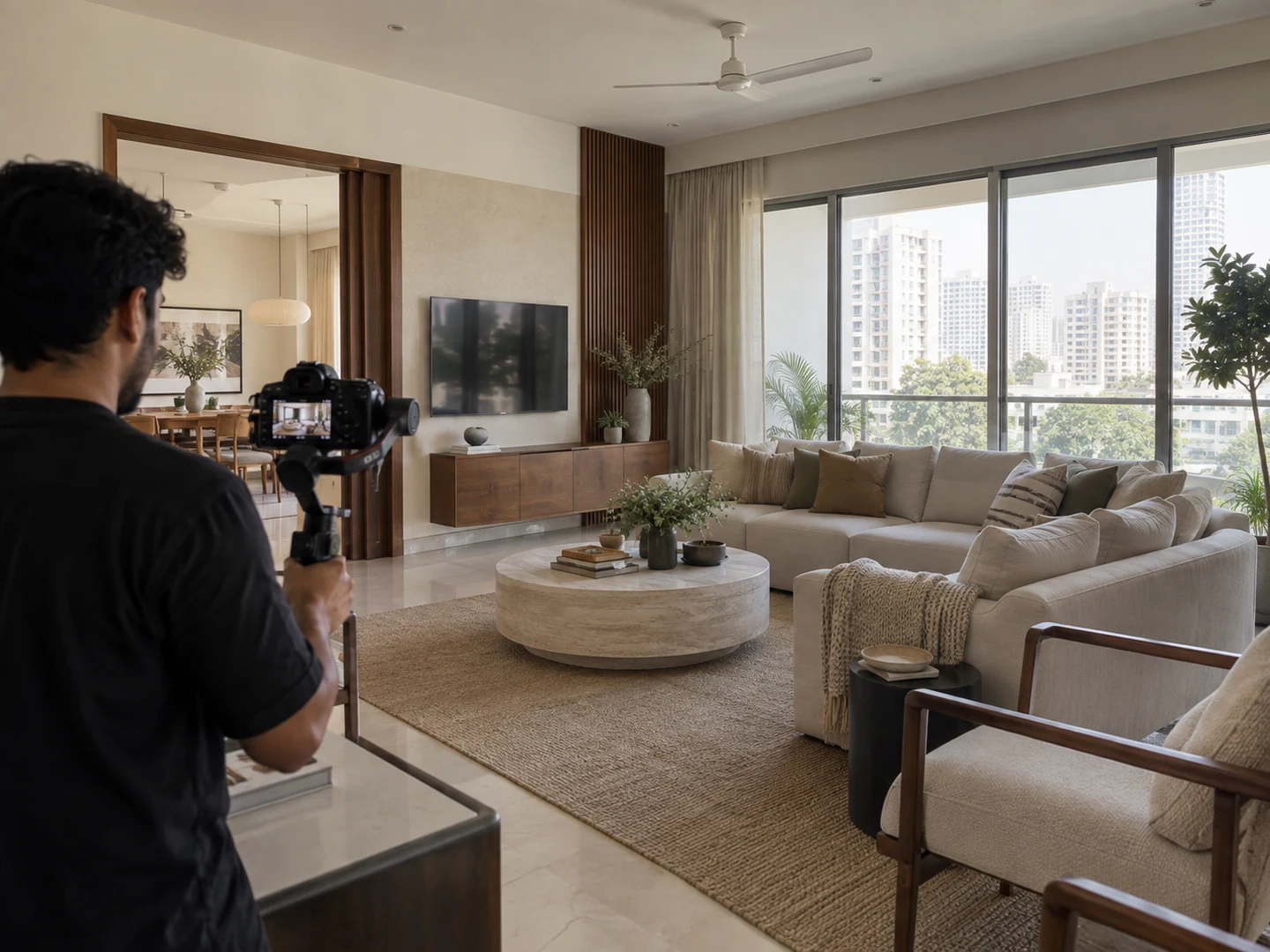
A property shoot becomes more useful when you plan the questions each asset will answer before filming begins. One project overview cannot carry every detail a prospective buyer needs. A coordinated set of short films, photographs, captions, and sales follow-up materials can give each question the right amount of attention.
For a Hyderabad developer, the starting point is the conversation already happening around the project. Ask the sales team what prospects request before a visit, what they misunderstand, and what needs explaining afterwards. Those questions can become a content plan grounded in the actual property rather than a calendar filled with generic promotional posts.
This guide covers social media content support, from shoot planning to review. Content production, publishing, paid campaign management, and enquiry handling are separate responsibilities that should be agreed explicitly.
TL;DR: Plan a content series around real buyer questions, then capture the evidence each answer needs. Give every asset a clear purpose, format, and next step. Review facts and captions before release, track the routes you can measure, and use sales feedback to improve the next shoot rather than promising a fixed content yield.
Which questions should your real estate social content plan answer?
Begin with questions the project team actually receives, then group them by the decision they support. Someone discovering the development needs orientation. Someone considering a visit may need layout or access information. A prospect following up afterwards may need a specific detail. These situations call for different content, even when the footage comes from the same shoot.
Ask marketing and sales to gather examples from their own interactions without including personal customer information in the working document. Record the question in everyday language. “How does the dining area connect to the balcony?” is more actionable than a broad theme such as “premium lifestyle.”
Then check whether the team can answer each question with current evidence. Some topics need footage; others need an approved plan, specification, or factual explanation. If an answer depends on unconfirmed information, keep it out of the release schedule until the responsible person approves it.
Prioritise questions that are relevant to the current project stage. Content for a completed show apartment should not imply that every building or amenity has reached the same point. The project marketing brief can hold the common facts so all outputs use consistent wording.
How do you turn those questions into a shoot plan?
Map each question to the scene, supporting information, and format it requires. This exposes missing coverage before filming and helps the crew distinguish essential material from optional variations. A content plan should describe what each asset explains, not simply request a large quantity of reels from whatever footage happens to be available.
| Content purpose | Question to answer | Material to capture | Possible output |
|---|---|---|---|
| Introduce the setting | Where does the project sit? | Approved exterior and contextual coverage | Short introduction |
| Explain the layout | How do the main rooms connect? | Continuous route and supporting angles | Walkthrough edit |
| Show a specific feature | What does this detail look like? | Detail plus a wider contextual frame | Focused feature film |
| Support a sales conversation | What should I review before visiting? | Relevant spaces and approved information | Follow-up video or image set |
| Clarify the next step | How do I arrange a visit? | Current contact information and agreed wording | Closing graphic or caption |
Discuss dedicated vertical framing, photography, spokesperson segments, and clean footage without overlays during planning. Some scenes can support several assets; others need their own capture. Agree the output list with the production team rather than treating potential reuse as a promise that any number of edits will be possible.
Use the property film shoot checklist to connect the content matrix to site access and presentation. A planned feature edit still depends on that feature being ready, accessible, and accurately described when the crew arrives.
How should each short video be structured?
Give each short video a recognisable question, visual evidence, and an appropriate next step. The opening should tell viewers what they are about to understand. The middle should deliver that information without unrelated footage. The ending can invite a relevant action, such as viewing the full walkthrough or requesting current project details.
For a hypothetical layout edit, the opening might ask how the living and dining spaces connect. The footage then follows that relationship, with concise labels where needed. The closing can direct interested viewers to the full project information. This is an editorial example, not a performance claim or a script that suits every development.
Do not confuse a platform's maximum duration with the ideal length of your message. YouTube says eligible square or vertical uploads of up to three minutes are classified as Shorts under its current rules for standard channels. That gives publishing flexibility; it does not mean every feature needs three minutes. (YouTube Help, accessed 2026.)
Write for the amount of explanation the question needs. A visual detail may need little text. A layout explanation may require a longer sequence. If the edit introduces several unrelated ideas, split the message before trimming essential context just to make it shorter.
How do captions and language affect the final content?
Captions should accurately carry the spoken message and remain readable within the intended format. Treat them as part of the editorial work rather than an automatic final step. Project names, place names, measurements, and mixed-language speech deserve particular attention because a small transcription error can change the meaning of a property statement.
YouTube warns that automatic captions can contain errors and recommends reviewing them. Its supported languages include English and Telugu, but availability does not remove the need to check the output. Confirm names, punctuation, and factual wording against the approved script before publication. (YouTube Help, accessed 2026.)
Decide language requirements while preparing the brief. A translated voice-over, a bilingual caption, and a separate language edit involve different work. Ask the person approving the language to review meaning as well as spelling. Literal translation may not communicate the intended property detail clearly.
Review the complete asset on a phone. Check whether captions cover an architectural feature, whether the closing contact information remains visible, and whether any platform interface could interfere with essential text. Keep an export record so revised captions do not leave an older version circulating alongside the approved file.
How should you organise the real estate social content series?
Publish content in an order that helps someone learn about the project, while allowing each asset to make sense independently. A viewer may encounter the layout edit before the introduction. Include enough context to identify the subject, and connect related assets through clear captions or links where the publishing channel supports them.
Start with a manageable set that the team can review and maintain. An introduction can establish the project; feature content can answer specific questions; sales follow-up assets can provide deeper information. The publishing rhythm should reflect available material, review capacity, and the project stage rather than an arbitrary demand to post daily.
Keep a content register with the asset name, question answered, project phase, factual reviewer, approved version, intended channel, and next review trigger. A review trigger might be a specification change, new site progress, or changed contact details. This makes accuracy part of the content plan after release as well as before it.
Separate evergreen explanations from time-sensitive messages. A film explaining a layout may remain useful longer than a post about availability. Both need review, but they should not share the same assumptions about how long the information stays current.
Measure the response without overstating what content proves
Choose measures that match the asset's purpose and the data your team can actually observe. Viewing behaviour may help assess an opening or edit. Website visits can help assess a linked next step. Sales feedback may show whether the material answered a recurring question. None of those observations alone proves that a film caused a sale.
For links to a website, consistent campaign parameters can help identify referring sources in analytics. Google documents the use of parameters such as source, medium, and campaign for traffic attribution. Agree a naming approach with the person managing measurement before sharing links across channels. (Google Analytics Help, accessed 2026.)
Review patterns alongside context. A post may attract interest because of its topic, distribution, timing, or existing audience, as well as its creative execution. Avoid announcing a creative winner from a comparison where every condition changed. Use the observations to form a clearer question for the next round of content.
Bring the sales team back into the process. Did prospects understand the layout before visiting? Which details still needed explanation? Did the shared asset match the question asked? These observations do not replace quantitative reporting, but they can reveal useful gaps that a view count cannot describe.
Frequently asked questions
A shoot-based social plan works best when the desired outputs are discussed before production and the responsibilities after delivery are clear. The amount of usable content depends on the property, coverage, message variety, and approved scope. Avoid treating a shoot as an unlimited source of distinct stories when the available evidence is narrow.
How many social videos can we get from one property shoot?
There is no reliable fixed number without reviewing the brief and coverage. Different buyer questions, dedicated framing, and varied scenes can support distinct edits. Repeating similar footage with new music does not necessarily create a useful new asset. Agree the expected deliverables before filming and assess additional edits separately.
Can the same content support the sales team?
Yes, when it answers a question relevant to a sales conversation. A layout explanation or focused amenity overview may help a prospect review information after an enquiry. Plan that use explicitly, keep facts current, and provide a version suitable for sharing rather than assuming every social export meets the same need.
Does social content production include paid advertising?
Not automatically. Producing films, images, and captions is a different scope from buying media, managing campaigns, or handling enquiries. Agree which responsibilities are included and who owns the others. Content can support a campaign, but its production alone should not be presented as a guarantee of leads or sales.
Plan the next shoot from what people still need to know
Begin with a short list of real project questions and connect each to a scene, verified fact, and intended output. Review that list with production before the shoot, then carry it into captions, approvals, and distribution. This gives the team a shared definition of what makes an asset useful.
After release, collect the questions that remain unanswered and use them to shape the next brief. The aim is a growing library of clear, accurate project information that supports discovery and sales conversations. For the underlying production, connect the plan to the appropriate property film and photography service.