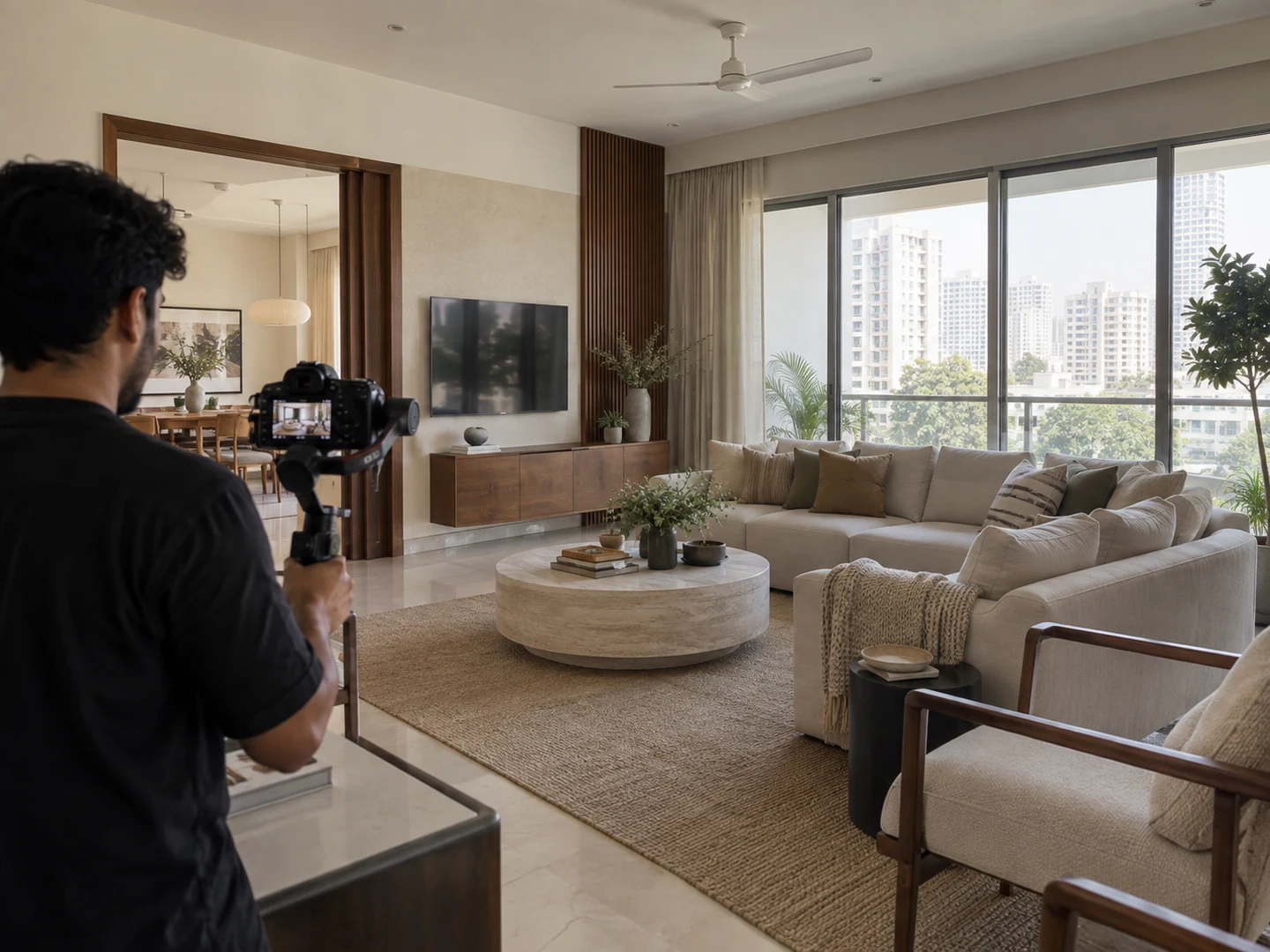
A useful real estate project marketing brief tells the creative team what buyers need to understand, what evidence supports the message, and where the finished work will appear. It connects your commercial priorities to the practical decisions behind photography, films, aerial footage, and social content.
For a Hyderabad developer, the challenge is often choosing what deserves attention. A project might have an impressive entrance, a distinctive layout, and a convenient approach road. Putting every feature into the opening film can leave viewers unsure what makes the project relevant to them. Begin with the question the content needs to answer, then build the production around it.
This guide provides a working structure for a real estate project marketing brief, including a claims register, deliverable matrix, and approval process.
TL;DR: Start with the audience, their main question, and the evidence your project can show today. Translate that into a message, a shot requirement, and a specific deliverable. Confirm facts, responsibilities, and review deadlines before production. A brief should help people make decisions without needing to guess what the developer intended.
What should a real estate project marketing brief establish first?
Establish the project stage, the audience, and the immediate communication objective before discussing visual style. These choices determine which spaces matter, what footage is possible, and what the final content should ask viewers to do. A completed residence and a project under construction need different evidence, even when both target similar buyers.
Adobe's guidance on discovery briefs recommends defining goals, audience, and success measures, alongside deliverables and practical constraints. That is a useful starting structure for a property assignment; the project team must supply the specific evidence and priorities. (Adobe, accessed 2026.)
Write the project description in plain language. Include its approved name, location, development type, current stage, and the inventory or phase covered by the assignment. Distinguish the whole development from the specific portion being filmed. A clubhouse under construction, for example, should not enter the brief as a completed amenity.
Then choose an audience more precise than “premium buyers.” Describe the decision context: families comparing usable space, buyers evaluating access, or prospects who have already spoken with sales. Avoid inventing audience preferences. Use actual questions from enquiries and site visits, and identify assumptions that still need testing.
Finish this section with a clear objective: explain the layout before a visit, introduce the project to a new audience, or answer recurring questions after an enquiry. These objectives can coexist across a campaign, but an individual asset should have a recognisable job.
Check the result: Ask someone outside the project team to summarise the assignment. If they can name the audience, the key question, and the requested next step, the brief has a usable foundation.
How do you turn project features into a clear message?
Translate each feature into a question the viewer might ask, then identify the evidence needed to answer it. This keeps the creative direction grounded in the actual property. Broad descriptions such as “exceptional living” provide little guidance unless the brief explains which spaces, details, or verified facts support that impression.
Use a message-to-evidence table to test the idea before commissioning footage:
| Feature under discussion | Viewer question | Evidence to prepare | Suitable content |
|---|---|---|---|
| Living and dining arrangement | How do the spaces connect? | Approved plan and clear walkthrough route | Continuous interior sequence |
| Arrival experience | What happens when I enter? | Accessible approach and completed entrance | Ground-level arrival film |
| Outdoor setting | What surrounds the development? | Current site context and verified location labels | Contextual aerial sequence |
| Material finish | What does the specification look like? | Installed example and approved specification | Detail photographs |
Treat this as a planning tool, not a claims generator. An attractive image can demonstrate appearance, but it cannot establish structural quality or future performance. Pair visuals with the correct supporting documents whenever the message goes beyond what the camera can show.
Choose a primary message and a small supporting set. What would a viewer remember if they watched only the opening? If the answer is a long feature list, narrow the direction. Additional questions can become separate edits, gallery captions, or sales follow-up assets.
What facts should be approved before creative work starts?
Approve every project-specific statement that the creative team may put into a script, graphic, caption, or voice-over. Keep those statements in a shared source document with their supporting evidence and reviewer. This reduces the chance that an outdated brochure or casual conversation becomes the basis of a published claim.
The register should cover names, location wording, area definitions, current amenity status, project milestones, and contact information. Add prices, offer terms, distances, or availability only when the authorised team has supplied current wording. Give time-sensitive facts a review date so they are easy to recheck before release.
Use clear statuses: approved, needs verification, and excluded. A blank cell is ambiguous. An explicit “do not use” instruction prevents an editor from filling a gap with a phrase found elsewhere. Keep the record close to the working brief so revisions do not spread across disconnected messages.
For a hypothetical project, the team might approve “show apartment available for visits” while withholding a proposed amenity opening date. The film can then show the available apartment without implying the rest of the development has reached the same stage. Label the example as a planning scenario rather than a completed case study.
Check the result: Every factual statement in the proposed script should point to an approved entry. Anything without a source returns to the project team before production or publication.
Which deliverables does the real estate project marketing brief need?
Specify what each finished asset will do, where it will appear, and what production work it requires. A request for “one video and social content” leaves too many decisions unresolved. The same footage may support several outputs, but each output still needs its own framing, narrative, text, and approval requirements.
| Deliverable | Intended use | Content requirement | Approval owner |
|---|---|---|---|
| Project overview film | Project page or sales presentation | Coherent introduction and verified facts | Marketing lead |
| Layout walkthrough | Follow-up after an enquiry | Clear spatial sequence | Sales and project teams |
| Vertical feature edit | Social discovery | A focused question and suitable framing | Marketing lead |
| Photography selection | Website and collateral | Agreed spaces, details, and usable crops | Marketing lead |
Record orientation, expected duration range, language, captions, music requirements, and delivery format alongside the matrix. Specify whether clean versions without graphic overlays are required. Confirm how the team will handle raw footage, project files, usage rights, and later re-edits rather than assuming these form part of every assignment.
Plan social requirements before filming. A wide interior shot may not retain its meaning when cropped vertically. The property film shoot checklist helps translate the deliverable matrix into coverage and site preparation.
How should you organise access, approvals, and changes?
Assign responsibility for site access, factual verification, creative feedback, and final release before the shoot. These are different decisions and may involve different people. A named contact for each prevents the production team from treating an informal comment as approval or waiting for someone who cannot authorise the next step.
Create a simple sequence: brief approval, outline approval, shoot readiness, first edit, consolidated feedback, and release. Agree the review windows with the people involved. Avoid setting a public launch date solely around the filming date; editing and factual review still need space in the schedule.
Consolidate comments into a single review document. Feedback such as “make it more premium” needs translation into a decision: quieter music, less text, more architectural detail, or a slower opening. Conflicting comments should be resolved by the project team before they reach the editor.
Separate corrections from changes in direction. A misspelled project name is a correction. Replacing an approved walkthrough with a presenter-led film changes the assignment. Naming the distinction makes scope conversations clearer without assuming either request is unreasonable.
Record dependencies as well. If access to the terrace remains uncertain, identify a ground-level alternative. If aerial coverage is important, connect the brief to a separate aerial shot plan and let the operator confirm feasibility.
A compact brief you can use in your kickoff meeting
A kickoff brief should be short enough to discuss while containing the decisions production depends on. Supporting documents can hold specifications, brand assets, and detailed approvals. The main brief should remain the working reference that explains the assignment and makes omissions visible before they become problems on location.
Bring answers to these prompts:
- Project: What exact phase, building, or inventory does this assignment cover?
- Audience: Who will see the content, and where are they in their decision?
- Question: What should they understand after viewing it?
- Evidence: Which available spaces and approved facts answer that question?
- Deliverables: Which formats and uses must the production support?
- Constraints: Which spaces, dates, claims, or activities are unavailable?
- Review: Who checks facts, combines feedback, and approves release?
- Next step: What action should interested viewers take?
Read the answers together before discussing visual references. References are useful for mood, pacing, and framing, but they cannot establish the facts of your project. A beautiful reference with different architecture, access, or lighting may require a different production approach.
Frequently asked questions
A brief does not need to contain every creative decision, but it should settle the information only the project team can provide. Audience, factual accuracy, access, and business priorities belong with the developer. The production team can then recommend how to express those decisions through images, sound, editing, and appropriate formats.
Can a brochure serve as the project marketing brief?
A brochure can supply approved information and visual references, but it rarely explains the assignment fully. Add the intended audience, communication objective, deliverable list, access conditions, and approval process. Check that the brochure remains current before treating its specifications or amenity descriptions as a source for new content.
Do we need separate briefs for film and social content?
Use a shared project brief with format-specific requirements. The core facts and positioning should remain consistent, while each asset has its own purpose and structure. The social content planning guide explains how to organise these variations before filming rather than improvising them during editing.
What if the project is still under construction?
State the current stage clearly and identify exactly what the team can show. Separate completed spaces, work in progress, show apartments, and visualisations. Let the available evidence shape the story, and revisit the brief as the site changes instead of presenting future features as existing conditions.
Prepare the brief before booking production
The best next step is a working session with marketing, sales, and the person who can verify project facts. Use the questions above to agree the audience, message, evidence, and output. Mark unresolved decisions explicitly and assign each to someone who can resolve it.
Once the brief is clear, move to site readiness and shot planning. Production becomes easier to assess when everyone knows what the content must explain and how approval will work. You can then judge the finished assets against the assignment, rather than relying only on whether the images look impressive.